
UNIX — The Ideas That Shaped Linux
Before diving deeper into Linux and cybersecurity, I wanted to understand where Linux came from and the ideas behind it. That led me to UNIX, an operating system whose design and influence helped shape modern computing.
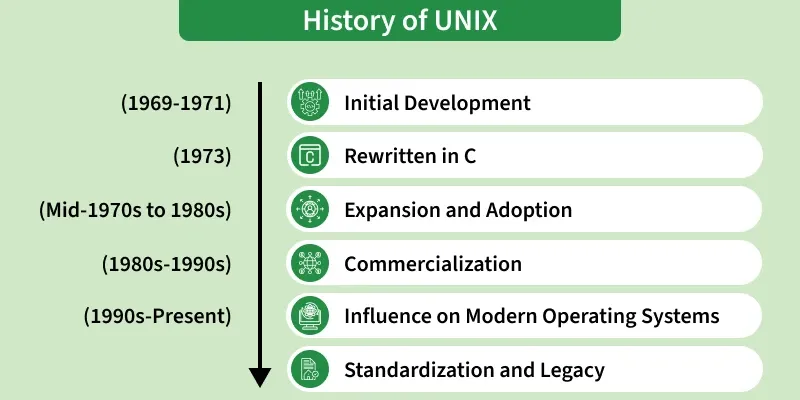
UNIX began at AT&T Bell Labs in 1969. Its development introduced ideas and tools that influenced operating systems for decades, including Linux and other Unix-like systems.
🕰️ The Beginning of UNIX
UNIX was initially developed by Ken Thompson, Dennis Ritchie, and their colleagues at Bell Labs. Early development took place on a PDP-7, an 18-bit minicomputer made by Digital Equipment Corporation (DEC).
The first edition of UNIX appeared in 1971. A major milestone came in 1973, when its kernel was rewritten in C, making it significantly easier to port UNIX to different hardware architectures.
💡 Why C mattered: Earlier operating systems often relied heavily on assembly language tied to specific hardware. Writing much of UNIX in C improved its portability and maintainability.
⚙️ Understanding the Structure
UNIX is known for its structured design and command-line environment. To understand how it works, it helps to distinguish between its major components.
- Kernel: Manages processes, memory, hardware access, and other core system resources.
- Shell: Interprets commands and provides an interface between the user and the system.
- Utilities: Programs that perform tasks such as listing files, searching text, and managing processes.
- Filesystem: Organizes files and directories in a hierarchical structure.
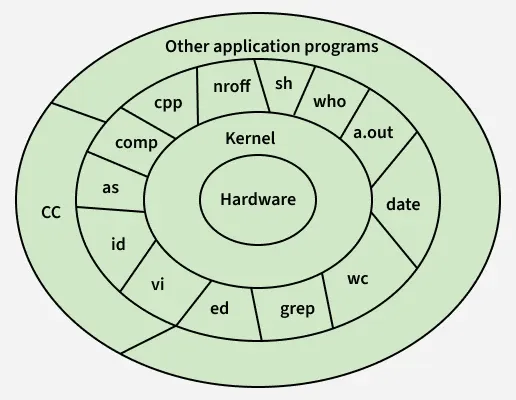
These components work together to provide an environment in which users can run programs, manage files, and interact with the system.
UNIX also became known for multiuser and multitasking capabilities, along with the idea of building small tools that work together to accomplish larger tasks.
🌀 The Evolution of UNIX
As UNIX spread beyond Bell Labs, different groups developed their own versions and extensions. Two important historical families emerged: BSD and System V.
Commercial vendors also developed their own UNIX systems, including Solaris (SUN), HP-UX (HP), AIX (IBM), DEC UNIX.
Another important development was the emergence of Linux in 1991. Linux adopted many ideas associated with UNIX, but it was developed independently as a Unix-like kernel rather than being copied from the original UNIX source code.
| Name | What it represents |
|---|---|
| BSD | A major Unix-derived family |
| System V | An important AT&T UNIX lineage |
| Solaris | UNIX associated with Sun Microsystems |
| HP-UX | UNIX developed by Hewlett-Packard |
| AIX | UNIX developed by IBM |
| Digital UNIX | UNIX developed by Digital Equipment Corporation (DEC) |
| Linux | An independently developed, Unix-like kernel |
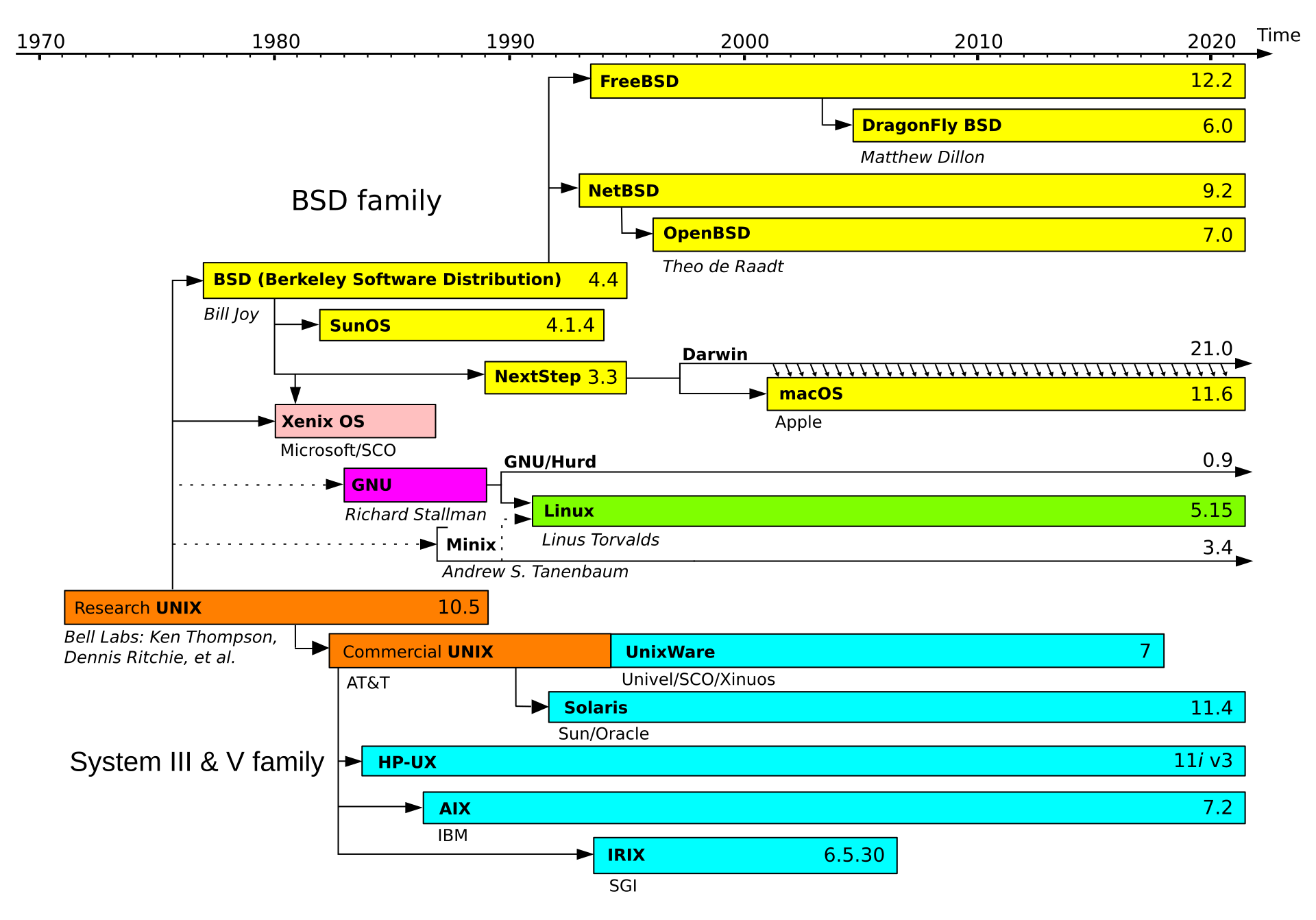
📝 An important distinction: UNIX is an operating-system lineage and a trademark used by qualifying certified systems. Linux is a kernel used in Linux distributions. The two are related in design and influence, but they are not the same thing.
🔍 What I Learned
Studying UNIX helped me understand that learning Linux is not just about memorizing terminal commands. It also means understanding why operating systems are designed the way they are, how they evolved, and how processes, filesystems, permissions, and system resources work together.
These foundations are also relevant to cybersecurity, where understanding how an operating system works is essential to analyzing and securing it.
❓ Questions for Further Exploration
While studying UNIX, I came across several questions that deserve a deeper look:
- What exactly was the PDP-7, and why was it used for early UNIX development?
- How did BSD and System V evolve, and what distinguishes them?
- What is POSIX, and how does it help operating systems and applications work together?
- How did UNIX variants such as Solaris, HP-UX, AIX, and Digital UNIX develop?
I'll explore these topics as I continue my journey.
📝 Notes & References
This journal is part of my Linux Journey series on Gyroove.com, documenting what I learn, the questions I encounter, and the concepts I explore along the way.