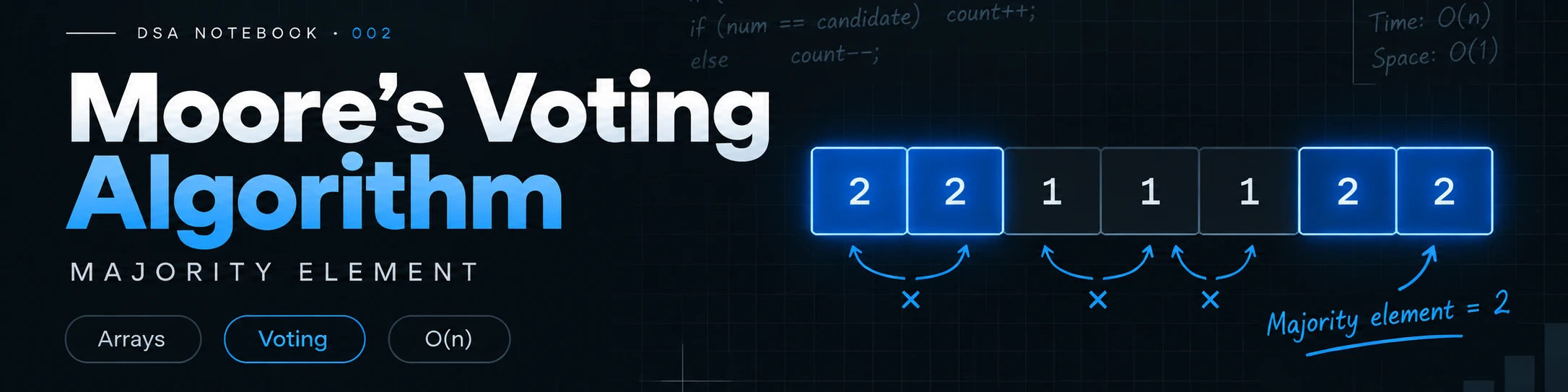
Moore's Voting Algorithm - Finding the Majority Element
1. Problem Statement
Given an array of integers nums of size n, find the element that appears more than n / 2 times.
A majority element, if it exists, occurs more than half the time.
Example
Input:  nums = [2, 2, 1, 1, 1, 2, 2]
Output: 2
The element 2 appears 4 times in an array of size 7. Since 4 > 7 / 2, it is the majority element.
2. Core Intuition
The key idea is cancellation.
- If the current element matches the candidate, increase the count.
- If it differs, decrease the count.
- If the count reaches zero, choose the current element as the new candidate.
Why does this work?
A majority element appears more than all other elements combined. Therefore, even if we pair each occurrence of the majority element with a different element, some occurrences of the majority element will remain.
3. Algorithm
Maintain two variables:
candidate: the current potential majority element.count: the current voting balance.
- If
count == 0, select the current element as the candidate. - If the current element equals the candidate, increment
count. - Otherwise, decrement
count. - After processing the array, the candidate is the majority element if a majority is guaranteed to exist.
If the problem does not guarantee a majority element, perform a second pass to verify the candidate's frequency.
4. Dry Run
Consider:
nums = [2, 2, 1, 1, 1, 2, 2]| Element | Candidate | Count |
|---|---|---|
| 2 | 2 | 1 |
| 2 | 2 | 2 |
| 1 | 2 | 1 |
| 1 | 2 | 0 |
| 1 | 1 | 1 |
| 2 | 1 | 0 |
| 2 | 2 | 1 |
Final candidate: 2
Its actual frequency is 4, which is greater than 7 / 2. Therefore, 2 is the majority element.
5. C++ Implementation
This version assumes a majority element is guaranteed to exist, as in LeetCode 169.
class Solution {
public:
    int majorityElement(vector<int>& nums) {
        int candidate = 0;
        int count = 0;

        for (int num : nums) {
            if (count == 0) {
                candidate = num;
            }

            if (num == candidate) {
                count++;
            } else {
                count--;
            }
        }

        return candidate;
    }
};
When a Majority Is Not Guaranteed
Verify the candidate before returning it.
class Solution {
public:
    int majorityElement(vector<int>& nums) {
        int candidate = 0;
        int count = 0;

        for (int num : nums) {
            if (count == 0) {
                candidate = num;
            }

            if (num == candidate) {
                count++;
            } else {
                count--;
            }
        }

        count = 0;

        for (int num : nums) {
            if (num == candidate) {
                count++;
            }
        }

        return count > nums.size() / 2 ? candidate : -1;
    }
};
Here, -1 represents the absence of a majority element, assuming it is the required sentinel value.
6. Complexity Analysis
- Time Complexity:
O(n)— one pass, or two passes when verification is required. - Auxiliary Space:
O(1)— only a constant number of variables are used.
7. Edge Cases
| Input | Expected result |
|---|---|
[5] | 5 |
[3, 3, 3, 3] | 3 |
[1, 2, 1] | 1 |
[1, 2, 3] | No majority element |
The last example demonstrates why verification is necessary when the problem does not guarantee a majority element.
8. Common Mistakes
- Assuming the final candidate is always the majority element.
- Forgetting to reset the candidate when
count == 0. - Confusing
count == 0with the absence of a majority element. - Using extra space to store element frequencies when
O(1)auxiliary space is sufficient.
9. Quick Revision
- Algorithm: Moore's Voting Algorithm.
- Purpose: Find an element occurring more than
n / 2times. - Core idea: Cancel votes between different elements.
- Time Complexity:
O(n). - Auxiliary Space:
O(1). - Verification: Required when a majority element is not guaranteed.
10. Practice Problems
- LeetCode 169 — Majority Element — implement the basic algorithm.
- LeetCode 229 — Majority Element II — find elements appearing more than
n / 3times. - GeeksforGeeks — Majority Element — practise the standard problem.
Remember: Moore's Voting Algorithm identifies a candidate through cancellation; the majority guarantee or a verification pass establishes whether that candidate is actually the answer.